



BY JILLIAN DRACHMAN
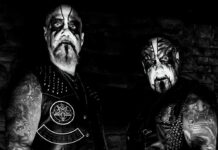
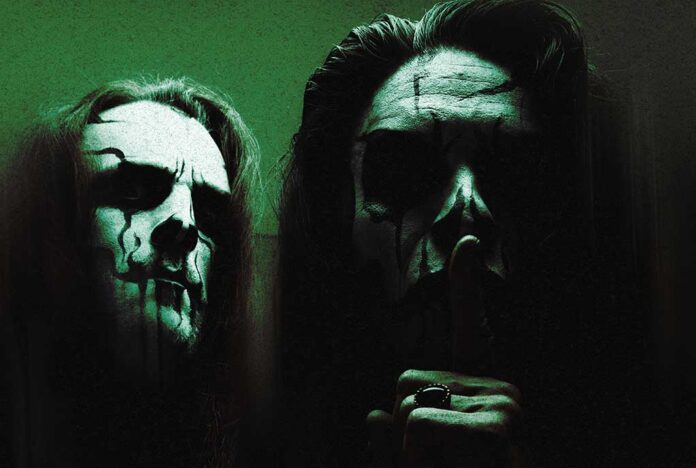
Carach Angren has not only become established as one of the best horror metal acts, but also one of the most skilled black metal outfits. Verily, the gentlemen behind Carach Angren, Ardek and Seregor, are insanely gifted. Their talents are all too magnificently displayed on the EP The Cult of Kariba, which reaffirms Carach Angren’s continued originality. As Ardek states, “We do our own thing. I think it’s cool when a band does something different.”
Ardek illuminates The Cult of Kariba’s concept, “It all goes back to our first album, Lammendam, from 2008. When Seregor and I were talking about that album, he found out that there might be another dimension to the story that we didn’t know about, because often with legends and urban myths, over time, things are added or detracted, and things spin off. We found out that there’s another layer to the story, specifically talking about a witch called Kariba, so we started digging deeper.”
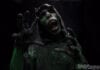
He elaborates, “For example, I found a poem that was written in 1870. I actually contacted the library that has it in their archive, and they sent me a copy of it. That was pretty cool. We found a picture from the 1970s that was actually from a theater play in the village, depicting part of the story — in an old newspaper, there was a picture of the theater group, and they were wearing costumes and masks. That actually looked pretty creepy. And at the same time, I was reading some short stories by Lovecraft. I came up with the idea: What if there was a cult secretly trying to resurrect this ghost?! I found that very fascinating because, if there’s a secret cult, and you don’t know about it, it can be pretty scary. Your neighbor or someone you know could be part of it.”
The EP’s gorgeous opening, “A Malevolent Force Stirs,” features narration by Tim Wells. Ardek shares, “I wanted to go for this almost chamber orchestra sound. It had to feel a little bit claustrophobic right from the get-go, and it had to build up the tension because it’s building into the next song, ‘Draw Blood,’ with this more ritualistic kind of sound with low voices. I got that approach a little bit from the ’80s/’90s horror movie vibe of Dracula from that time and The Silence of the Lambs, not like a super big John Williams production but creepier. Tim Wells does great with the British accent. It sounds dark and very serious.”
Ardek offers insight into the next track, “When I wrote the lyrics for ‘Draw Blood,’ I started in a very literal way: There’s a cult leader, and it’s a linear story. But it’s cool to also then, at some point, let that go a little bit and go more into atmosphere.” “Draw Blood” is followed by “The Resurrection of Kariba.” Ardek comments, “That song is actually a combination of Seregor and I, which is very interesting. I started it, and then he added things to it and took some things out.
The penultimate composition, “Ik Kom Uit Het Graf,” stands apart from the other tracks sound-wise, bringing more of an industrial feel. Ardek explains its genesis, “One night, I woke up, and I had this melody in my head, this heavy bassline. I was like, ‘I have to write this down.’ So, I went down into my studio and recorded it. In just one or two days, this whole song came together. Then, I sent it to Seregor, and I was like, ‘What do you think?’ And he was like, ‘That’s awesome! Actually, I have this idea with Dutch lyrics. Maybe I can try it.’ He wrote those lyrics entirely. They turned out great and fit so well. It’s funny because it’s a very experimental song, like the guitars only come in halfway, and there are these breaks. But we love to experiment and try all these things.” Ardek describes Seregor’s lyrical concept thus, “The cult was trying to resurrect the white lady, but then her attacker came back.”
The Cult of Kariba’s finale, “Venomous 1666,” likewise contains some Dutch. “Some parts of the EP are inspired by the poem, especially in the last song. It worked really well. It just came naturally. ‘Venomous 1666’ began in English, and then I was like, ‘Okay, the witch is going to speak, and she’s going to speak in her mother tongue because the story is Dutch. I think it adds an extra dimension.”
Ardek confirms that working with Seregor is always smooth, “We are very fortunate to work together and have this perfect relationship. It’s just always flawless. I always wanted a band where I could be the main songwriter, and he’s this guy with these crazy ideas and visuals. He’s like an actor, and he also writes guitar parts and lyrics.” Ardek continues, “Even before the band was known at all, we’ve been doing things the same way; in a way, nothing has ever changed. As teenagers already, we were just getting excited about stories, trying out stuff, and being happy about that.” Ardek often discusses movies with Seregor and also does quite a lot of reading, “When you do that, things come naturally. So, when I start playing the piano, suddenly something comes into my mind.”
The Cult of Kariba additionally showcases the expertise of longtime associates Patrick Damiani on guitars and bass and Nikos Mavridis on violin. The former has done engineering work for the band since their debut, which he produced. Meanwhile, Gabe Seeber, who plays live with Carach Angren, gave an exceptional performance on drums, despite some rather challenging writing, courtesy of Ardek. One of Ardek’s dogs, Frodo, even made a special appearance, providing a wolf howl.
An incredibly versatile artist, Ardek has composed for film, television, commercials, theater, etc. He clarifies, “A song usually has a place, but it’s not really clear upon inception where it’s going to go, and you have to have patience.
Sometimes, things I wrote six years ago suddenly have a place in something on YouTube now or on TV.” Ardek has furthermore lent his expertise to other music industry heavyweights like Joe Lynn Turner, Pain, Lindemann (originally the super-duo of Rammstein’s beloved Till Lindemann and the venerable Peter Tägtgren of Pain and Hypocrisy), and Mr. Till Lindemann as a solo artist. Ardek praises Tägtgren’s humility, passion, and tireless drive, adding, “Peter is amazing, and it was an honor to work with him.”
Ardek actually crossed paths with photographer Stefan Heilemann (the extraordinary artist responsible for The Cult of Kariba’s cover as well as that of its 2020 predecessor, Franckensteina Strataemontanus) due to Lindemann’s debut album. “He did the Skills in Pills [2015] album with Till and Peter, and then there was a release party — I met him there. He’s a master of visuals. He came up with this green theme with a VHS kind of vibe, and I loved it. It’s really cool when you have so many people that you click with and that actually contribute something to the process.”
“Ik Kom Uit Het Graf” is accompanied by a stunning video shot in Serbia with a large, hardworking team under the direction of Lindemann and Rammstein collaborator Zoran Bihać. Ardek tells us, “I love Zoran. He is a brilliant guy and a master of film. He has a very-very distinct vision. He did the ‘Franckensteina Strataemontanus’ video. I sent him ‘Ik Kom Uit Het Graf,’ and he came up with the idea. I loved it from the get-go. The first question he asked me was, ‘If this Kariba witch was alive today, how would she live?’ We came to the conclusion she would probably be someone on the street, maybe an addict, because that’s how society treats people that are a little bit off. And then, the televisions draw her in, and there’s the pregnancy, so it became gruesome. There are some special effects, like when she’s eating the worm. The worm is moving its legs, and that took more than a week on special effects. I still have the worm. But the recording was really great and smooth. It was a fantastic experience.”
Of course, we encourage all those reading to greet Carach Angren on the road when these lords of sonic darkness stop by your area. I, for example, happened to catch Carach Angren put on one of the best live shows I’ve seen when they toured in support of This Is No Fairytale (2015) with Children of Bodom. Ardek reflects, “I remember we brought a lot of production. We had the graveyard set, and I had the moving keyboard back then. Initially, it was kind of rough because we had very short change-over times. The tour manager for Bodom was like, ‘Is this all going to work?’ But in the end, they were super cool, and they actually made space for us to do all of that stuff. It’s not very usual for a headliner to allow something like that. We were very fortunate.”
(Purchase The Cult of Kariba here. For updates, follow Carach Angren on Instagram here and their label, the celebrated Season of Mist, here.)